Tyndale’s New Testament
Wolf HallTyndale’s New Testament is a contraband English scripture whose presence in Thomas Cromwell’s household connects private reading to a widening public conflict over who may interpret Christian faith. Kept under lock and key, the Antwerp edition is at once a book to be read, a text moving through clandestine channels, and evidence that can expose its readers to investigation and imprisonment.
The book in Cromwell’s household
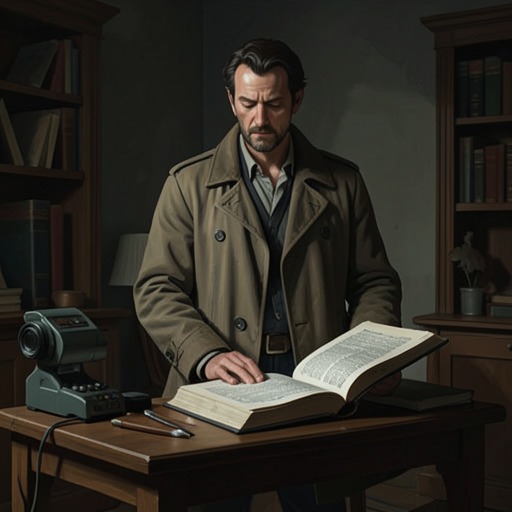
Cromwell keeps the New Testament in a locked chest and offers its key to Liz, encouraging her to read it herself because it is in English. She declines the invitation to read it alone and asks him to read it aloud instead. Her response marks a difference between the book’s potential availability and its actual use: the vernacular text can remove the need for Latin, but it does not automatically create a new reader or a new domestic practice. Cromwell does not imagine himself as a household preacher, and the book remains in the chest.
The copy is a pirated Antwerp printing, easier to obtain than the authorized German edition. Its octavo format and cheap paper distinguish it from the more costly books and manuscripts associated with powerful institutions. On its title page, the printer’s usual colophon and address are replaced by the words “PRINTED IN UTOPIA.” The false imprint disguises the place of production while giving the book an arresting claim to an imagined elsewhere. Cromwell hopes that Thomas More has seen a copy and is tempted to show him one, making the title page itself a possible provocation in their religious and intellectual opposition.
Circulation and censorship
The book reaches Cromwell through a wider movement of texts across the Channel and into England. He follows what is written abroad and what is smuggled through Channel ports and East Anglian inlets, then keeps Thomas Wolsey informed. When More and other clerics bring reports of new heresies, Wolsey can answer that he is already informed. His response does not mean that the books are left untouched: he burns books at St Paul’s Cross, where the destruction of English-language works makes censorship visible as a public act.
The New Testament’s circulation depends on people and routes as well as print. William Tyndale, its translator, had lodged for six months with Humphrey Monmouth before leaving London, and Cromwell knows him as a principled, hard man driven from his native shore. The book’s cheap, reproducible form stands in contrast to the official effort to control religious teaching, but its appearance in English also gives the dispute a practical urgency: readers can encounter scripture in a language they understand without relying on clerical mediation.
Reading, belief, and authority
For Cromwell, the New Testament belongs to a larger process of reconsidering inherited certainties. He wonders where the Bible speaks of purgatory, relics, monks, nuns, and the pope, and his questions register a change in how he understands religious authority. The book is not presented as the sole cause of that change; rather, its English text gives his doubts a concrete point of reference and makes scripture available for direct examination.
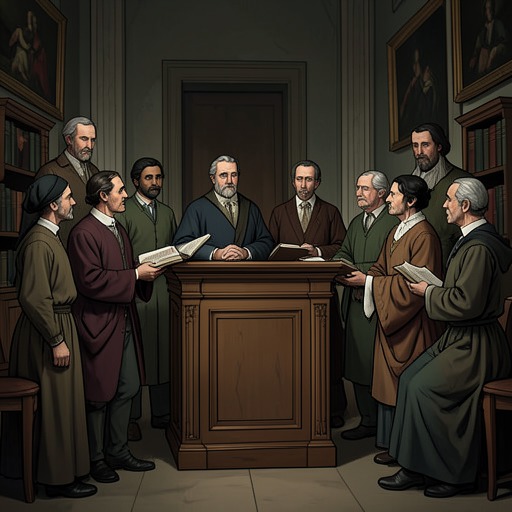
That possibility is contested. The king has written against Martin Luther with Thomas More’s help and received from the Pope the title Defender of the Faith. Wolsey agrees with Cromwell that Luther’s writings are dangerous, while continuing to monitor what enters the country. The New Testament therefore stands amid conflicting uses of textual authority: royal and clerical condemnation of reform, official destruction of books, and the claim that scripture itself can be read and judged outside the established chain of mediation.
Seizure and the danger to readers
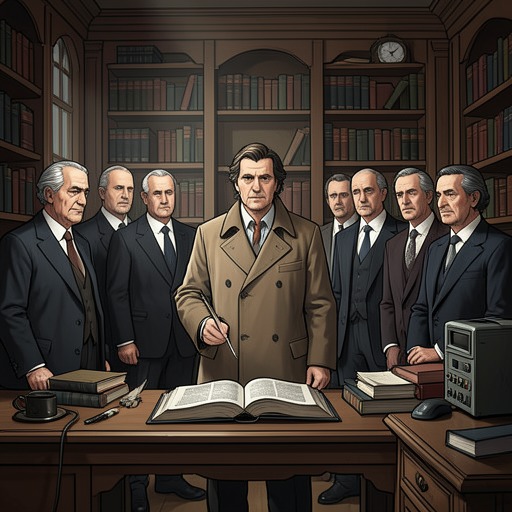
The book’s forbidden status has consequences for people who possess or defend it. During a search of John Petyt’s house, More and his officers look for the new books. Petyt has concealed papers, but a copy of Tyndale’s Testament lies under his desk. The search finds no books, yet More orders Petyt to go with the officers. The episode shows how possession can become a risk even when a search fails to establish what its investigators seek: the suspected reader is still taken into custody.
The New Testament also shapes Cromwell’s attempts to intervene. He helps bring about contact between Tyndale and the English court, and Tyndale says he wants to return home if the king will permit scripture in the mother tongue. He offers to accept the king’s choice of translator and submit to whatever punishment follows, provided the people of England may hear the gospel. But the translation is banned, Henry has not granted permission, and Cromwell comes to recognize the danger of pressing further: the king hesitates, while Tyndale will not bend his principles to gain royal favour.
The book appears again in Cromwell’s dealings with John Frith, whom he visits as a prisoner in the Tower. Cromwell has arranged for Frith to be kept above ground, with bedding, food, wine, paper, and ink, while warning him to put his writings away if he hears the key in the lock. The New Testament belongs to the same perilous world of English religious writing that has brought Frith under suspicion. Cromwell’s concern for the prisoner is practical, but it cannot remove the underlying danger of producing or circulating reformist texts.
A text gathered into power
The New Testament’s changing contexts reveal the instability of the line between illicit object and royal possession. When officials inventory Wolsey’s property, they pack up his gospels for the king’s libraries. Books can thus be taken from a fallen minister and absorbed into the collections of the Crown, even as unauthorized English scripture is banned and pursued. The distinction is not simply between books and their destruction; it is also between texts that power can collect and texts that threaten its control over religious interpretation.
At Austin Friars, Cromwell’s care for the book remains material and private: it is kept in a chest, offered to Liz with a key, and associated with the hidden traffic of printed works. Elsewhere, a copy becomes the object of a search, while the people linked to its circulation face confinement or exile. Tyndale’s New Testament therefore functions both as a readable scripture and as a vulnerable artifact. Its English language makes a claim about access to the gospel; its pirated printing, concealment, and seizure show how fiercely that claim is policed.